Inc.com: Letting Employees Work Remotely Pays Off

Link

Cambridge software firm Dimagi agreed to its employees’ request to spend part of the winter working in Brasil. The results? “By and large, the close quarters improved communication among co-workers, and bickering was rare. ‘There was a lot more casual asking questions across the table,’ says Zue. ‘And we tended to work later in the day than we would at home, since we were having dinner together almost every night.'”

Aeolus Community-Building Meetup #2

Yesterday we had our second Aeolus Community-Building Meeting. The idea was initially suggested by Nitesh, a community member who wanted to share some ideas for growing the community. We met a few weeks ago, with the notes published here.

This week we had a follow-up call, with much greater attendance.

We’ve been using Google Hangouts for these meetings with pretty good success. The videoconference aspect is pretty neat, and Mo had good luck with the screen-sharing aspect as well. This time we did an On Air Hangout, which allowed people to watch the stream live on Youtube, and for us to post a recording after the fact.

You can watch the recording here. (As a warning, my audio is really low, so if you crank the audio up for me, be prepared for everyone else to blow out your eardrums in comparison.)

Here’s a quick recap of what was discussed:

  • Mo Morsi gave a preview of his upcoming talks on Aeolus. He put the slides on the Aeolus Presentations wiki page.
  • We should have a release calendar on our site, and also make sure to make noise (on our blog, and on Twitter/Facebook/etc.) about our releases.
  • It would be valuable to look at integrating with CloudStack and documenting how to use it. Google Compute / Google Cloud Platform, too!
  • Our templates site is a really good idea that needs to be finished up and launched. The template repo Justin set up is a good interim solution.
  • It would be interesting to look at integrating with other sources of templates, like Bitnami or CloudFormation.
  • In general, we really need to support more providers, and finally arrive at a complete API.
  • Justin has been working on getting OpenShift Origin running on Aeolus. This would be an excellent blog post, and maybe a good marketing angle.
  • Sponsoring “drinkups” seems to work well for attracting interest, though it’s not clear if there’s actually a good return on it.
  • Someone suggested cotton candy at booths. I love that idea. Cotton candy kind of looks like a cloud, too!
  • Stickers and flyers are a must. We need to get a ton ordered.
  • We should do more with social media. We have a Facebook page and a Google Plus page, and we’re @aeolusproject on Twitter, and we have a blog. But we don’t make extensive use of them. What we really need are others to blog about us, retweet us, and share our stuff on Facebook.
  • We need to get people to take these tasks and commit to making them happen, and we should be in good shape for the next meeting!

Procedurally, we had some notes for how to make things go more smoothly next time:

  • I really, really need to buy a headset so that people can actually hear me.
  • When you have a large group of people who don’t all know each other, you should have people introduce themselves.
  • The 10-person limit is a problem. I think I might do a separate post on some things I have in mind for how to handle this next time.
  • We need an easier way to share the link ahead of time, both for the Hangout and for the live Youtube stream for people who don’t intend to participate.
  • We need to pay attention to IRC during the call, so those watching on Youtube can participate.

While comments are welcome on this post, please don’t do so at the expense of replying on aeolus-devel!

Aeolus and OpenStack: Today’s status

I’m currently working on a task to finally get Aeolus to play nicely with OpenStack. This work has been hamstrung in the past by various other components not supporting OpenStack, and then by some quirkiness with the OpenStack server I was trying to test against. The short version is that it doesn’t work yet, but hopefully will at the end of this sprint. What follows are some notes on where things stand right now.

If you’re on F16, you’ll need to gem install openstack, and then update to something newer than the 0.5.0-10 build of Deltacloud that’s in the Fedora repos. Fedora 17 has a new enough Deltacloud (it’s at 1.0.0-8 right now), but you still need to gem install openstack.

Marios has an excellent post from February (!) on using Deltacloud with OpenStack. This provided some clues I needed to get this running.

Right now, I had to start Deltacloud manually, with: deltacloudd -i openstack -P http://192.168.1.75:5000/v2.0 for this to work. -i openstack loads the OpenStack driver, and -P http://192.168.1.75:5000/v2.0 points Deltacloud to the OpenStack authentication URL. This corresponds to the OS_AUTH_URL value that may be created by an admin.

From there, you should be able to add the provider to Conductor:
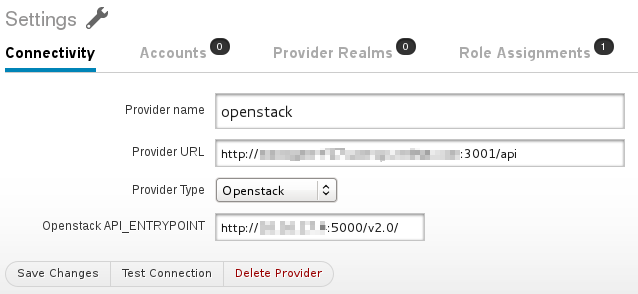
(Out of abundant paranoia I have blurred some internal IPs and hostnames, even though they’re not necessarily sensitive information.)

That screenshot leaves me wanting to clarify some of these fields in Conductor. “Provider URL” is the usual Deltacloud URL. (I just happen to be running it in a non-standard way.) I wish the text would indicate this. “Openstack API_ENTRYPOINT” is, well, the OpenStack API entrypoint, but I’d love to find a friendly name for this. This value also happens to be the exact same thing you passed in the -P flag to Deltacloud, which doesn’t seem as DRY as it could be, though I’m not sure if we can effectively share it between Deltacloud and Conductor.

Now, onto adding a Provider Account! This part is going to need some work.

As Marios mentions, OpenStack’s “v2” authentication actaully requires three fields — a tenant name, a username, and a password. For Deltacloud, you need to combine your username and tenant name with a ‘+’, e.g., “matt+mytenantname” and then enter your password normally. Today, you need to do this in the Provider Account screen. I intend to break these fields out in Conductor, though, so you enter the three fields normally.

Presently, this is as far as I can get because of BZ #858030, in which we reject hardware profiles that define “0 GB” of storage, as many OpenStack setups seem to do. I will send a (trivial) patch for that, though.

This is our current progress. After this, I’d like to move onto the real stuff — importing and building images, and launching instances!

Packages to Always Install

Over time, I’ve found that there’s a package of things that I think of as “core” packages that should be on any Linux box, but that aren’t actually included by default.

Here’s the latest list:

$ sudo yum install git bash-completion vim-enhanced bind-utils whois telnet screen

Most are self-explanatory. If you use bash and haven’t heard of bash-completion, check it out immediately. You’ll thank me later.

bind-utils is for dig, which strikes me as something that should be a standard package, along with whois and telnet for basic network diagnostics.

What’s on your list of “core” packages?